

Skin tags, papillomas, warts: what is actually on your skin
Several different lesions hide behind the term "skin growth". A dermatologist can tell them apart by eye and with a dermatoscope — and that is what decides whether the laser is the right choice.
- Soft fibromas (skin tags, acrochordons) — small stalked, skin-coloured growths, most often on the neck, armpits, under the breasts and in the groin. They appear with age, with excess weight and in pregnancy. Entirely benign, but they get in the way and become inflamed when they catch on clothing or jewellery.
- Viral warts (verrucae) — caused by HPV, so they are contagious and tend to recur. Typically on the hands, soles and in children. The laser is the answer where cryotherapy or topical treatment has failed.
- Seborrhoeic keratoses — flat to raised brown "stuck-on" lesions that multiply with age on the trunk and face. Benign, but often mistaken for moles, so they always go under the dermatoscope first.
- Xanthelasma — yellowish flat deposits on the eyelids. The laser is gentler here than a scalpel, because eyelid skin is thin and hard to suture.
- Small haemangiomas, milia, dermal naevi — some of these can also be treated with the laser after assessment by a doctor.
Tip: Photograph the growths that bother you next to a ruler or a coin for scale. It makes it much easier for the doctor to judge whether and how fast they are growing.
Why a CO₂ laser and not nitrogen, a scalpel or cautery
We use every one of these methods — just for different lesions.
| Method | Best for | Advantage | Drawback |
|---|---|---|---|
| CO₂ laser | skin tags, papillomas, warts, seborrhoeic keratoses, xanthelasma | precision to tenths of a millimetre, almost no bleeding, least visible mark | tissue is vaporised — no histology possible |
| Cryotherapy (liquid nitrogen) | viral warts, molluscum, small keratoses | no anaesthesia, quick, inexpensive | often needs repeating, blistering, risk of a pale patch |
| Surgical excision | moles and any lesion needing histology | sample goes to the lab, diagnostic certainty | sutures for 7–14 days, longer scar |
| Electrocautery | small skin tags | fast, widely available | more thermal damage to surrounding skin than the laser |
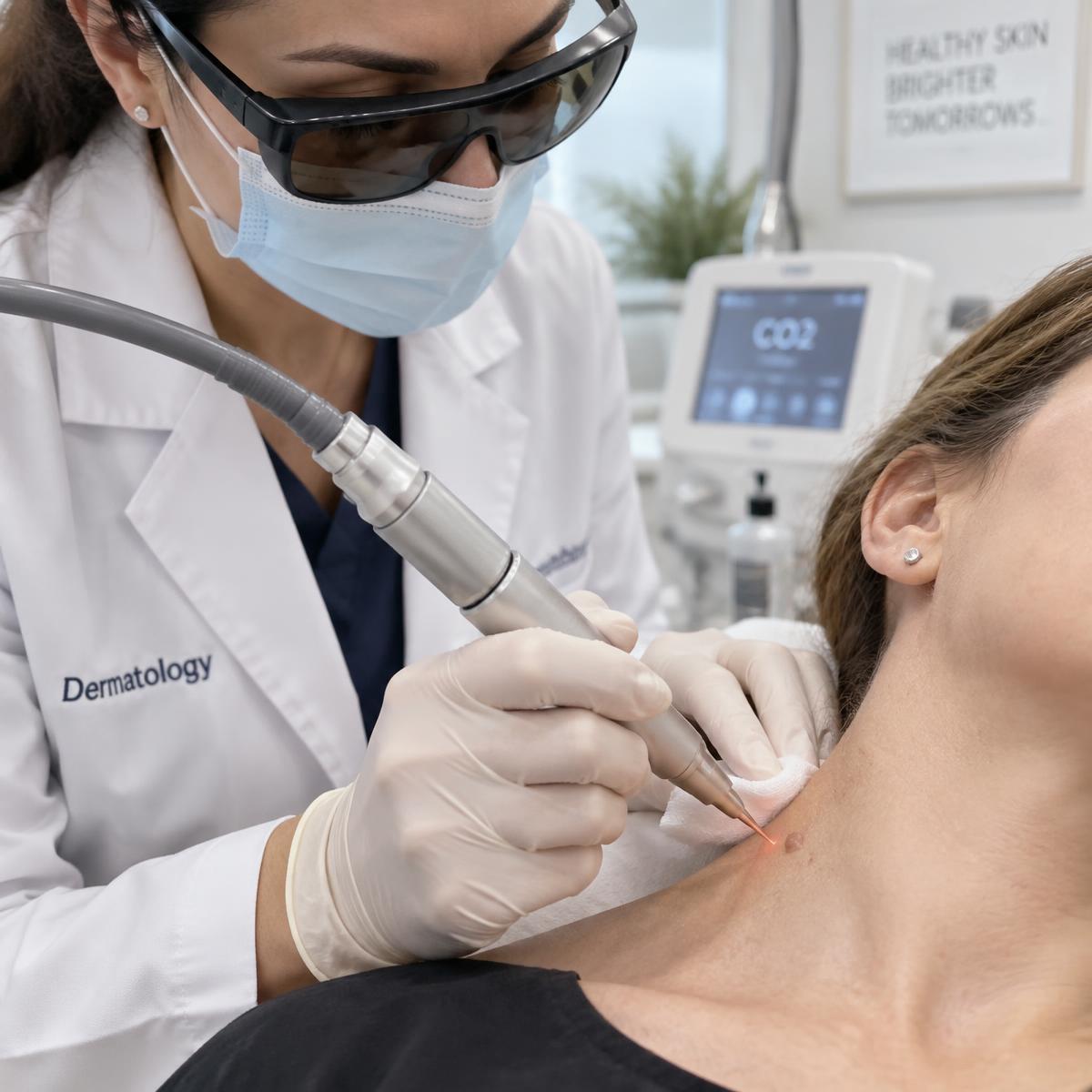
The CO₂ laser beam is absorbed by the water in the tissue. It vaporises the lesion layer by layer while sealing tiny vessels, so the surrounding skin is barely touched. Healing is therefore faster than after a cut and the final mark less noticeable. Read more about the device and its indications on the CO₂ laser page.
When the laser is not the right choice
The key rule: we only laser lesions with a clear diagnosis. The laser vaporises tissue, and vaporised tissue cannot be examined under a microscope. If the doctor has any doubt — a changing pigmented lesion, an irregular border, an ambiguous dermatoscopic picture — we choose surgical removal with histology. Histology usually takes up to 7 working days and is the only way to rule out skin cancer.
We also postpone the laser in case of:
- active infection or inflammation in the treated area,
- a tendency to keloid scarring (assessed individually),
- fresh tanning or self-tanner at the treatment site,
- pregnancy — the procedure is not dangerous, but purely cosmetic treatments are usually deferred until after delivery.
That is why every procedure starts with a dermatoscopic examination. If you have several growths and moles, it makes sense to combine removal with a full-body check in one visit.
The procedure step by step
- Dermatoscopic assessment. The doctor confirms the nature of the lesion and that it is suitable for the laser. Simple skin tags can be treated at the very first visit.
- Explanation and informed consent. We agree the extent and tell you the final price in advance.
- Numbing. Injected local anaesthetic (one small prick) or anaesthetic cream for tiny lesions. You feel nothing during the procedure itself.
- Laser removal. One skin tag takes tens of seconds; the whole session, even with several lesions, 20–30 minutes.
- Dressing and instructions. We cover the site and give you written aftercare instructions and a follow-up date.
Does laser removal of skin tags hurt?
No. Only the anaesthetic injection is unpleasant, comparable to a blood draw. For small stalked tags on the neck, anaesthetic cream is often enough. Once the anaesthetic wears off the site may be tender for a day or two, like a small graze; painkillers are usually unnecessary.
Healing day by day and aftercare
- Day 0–2: the site is red and may weep slightly. Leave it alone, do not touch it and avoid long soaking. Use the recommended ointment or dressing.
- Day 3–14: a crust forms. Never pick it off — it prolongs healing and worsens the result. It falls off by itself within one to two weeks.
- Week 2–8: new pink skin lies under the crust. Protect it from the sun — SPF 50 or clothing — until the colour matches the surrounding skin. Sunburnt pink skin can stay permanently darker.
- Sauna, pool, sunbed: avoid for at least a week, ideally until the crust is gone.
- Face and eyelids: heal fastest; make-up only after the crust falls off.
After removal, nothing usually returns at the same spot; new tags may appear elsewhere, which relates to predisposition rather than the treatment. Viral warts can recur, because they are an infection — so we combine the laser with consistent home care and a follow-up.
What laser removal of skin tags and warts costs in Prague
Laser removal of growths is a self-pay procedure. Indicative prices from our price list:
| Procedure | Price |
|---|---|
| Laser removal of skin growth (1 lesion) | from CZK 1,100 |
| Laser removal of a viral wart | CZK 650 |
| Injected anaesthetic / anaesthetic cream | CZK 100 |
| Dermatoscopic assessment of 1–3 lesions | CZK 500 |
The doctor sets the final price after the initial assessment, based on the number and size of the lesions, and you always know it before the procedure. Card and cash accepted.
Does insurance cover removal of skin tags?
Purely cosmetic removal is not covered by health insurance — that applies to all insurers. If the procedure is medically indicated (the lesion repeatedly becomes inflamed, bleeds, restricts movement, or histology is needed), we assess entitlement individually and usually choose insurance-covered surgical removal. We have contracts with VZP, ZP MV ČR, OZP, VoZP and ZPŠ — see the FAQ.
When to book
Book an appointment if a growth bothers you mechanically, has become inflamed, bleeds, is growing or changing colour, or you simply want clear skin. No GP referral is needed. CO₂ laser procedures are performed by Dr Olha Sydoriak, the clinic's lead physician.
DermatologyExpert, Vítězné náměstí 9, Prague 6 – Dejvice, 2 minutes from Dejvická metro.
Author: MUDr. Olha Sydoriak
Medically reviewed: