

Everyone has moles. The average adult body has between 20 and 40 pigmented nevi, which form gradually from birth up to about age 35. Most are entirely harmless. Some, however, can change over time and become a warning sign of skin cancer — the most dangerous of which is melanoma.
A timely mole check by a dermatologist is one of the most important preventive examinations you should have on your health calendar.
Why mole checks matter so much
In the Czech Republic, approximately 2,500 new cases of melanoma are diagnosed each year. Its incidence has more than doubled in the last 20 years.
The key message is simple: melanoma diagnosed early is curable in 95 % of cases. Once it spreads to deeper layers and creates metastases, the chances of successful treatment drop sharply.
When you should come for a mole check
The general recommendation is to have a preventive mole exam once a year. Don't wait, however, if:
- A mole is changing — growing, changing colour, shape or surface
- It bleeds, itches or hurts
- A new mole has appeared after age 35
- Family history of melanoma (raises risk 2–8×)
- You have more than 50 moles
- You had severe sunburns in the past, especially with blisters
- You repeatedly worked in the sun without protection or use tanning beds
ABCDE rule: how to recognise a suspicious mole at home
Check your own moles every 2–3 months.
A — Asymmetry. The two halves should match.
B — Border. Healthy moles have regular, smooth edges.
C — Colour. A safe mole has a uniform colour.
D — Diameter. Moles larger than 6 mm carry higher risk.
E — Evolution. Any change over time is the most important warning sign of all.
Tip: Photograph your moles in the same lighting every 3 months and compare.
What dermatoscopy is and how it works
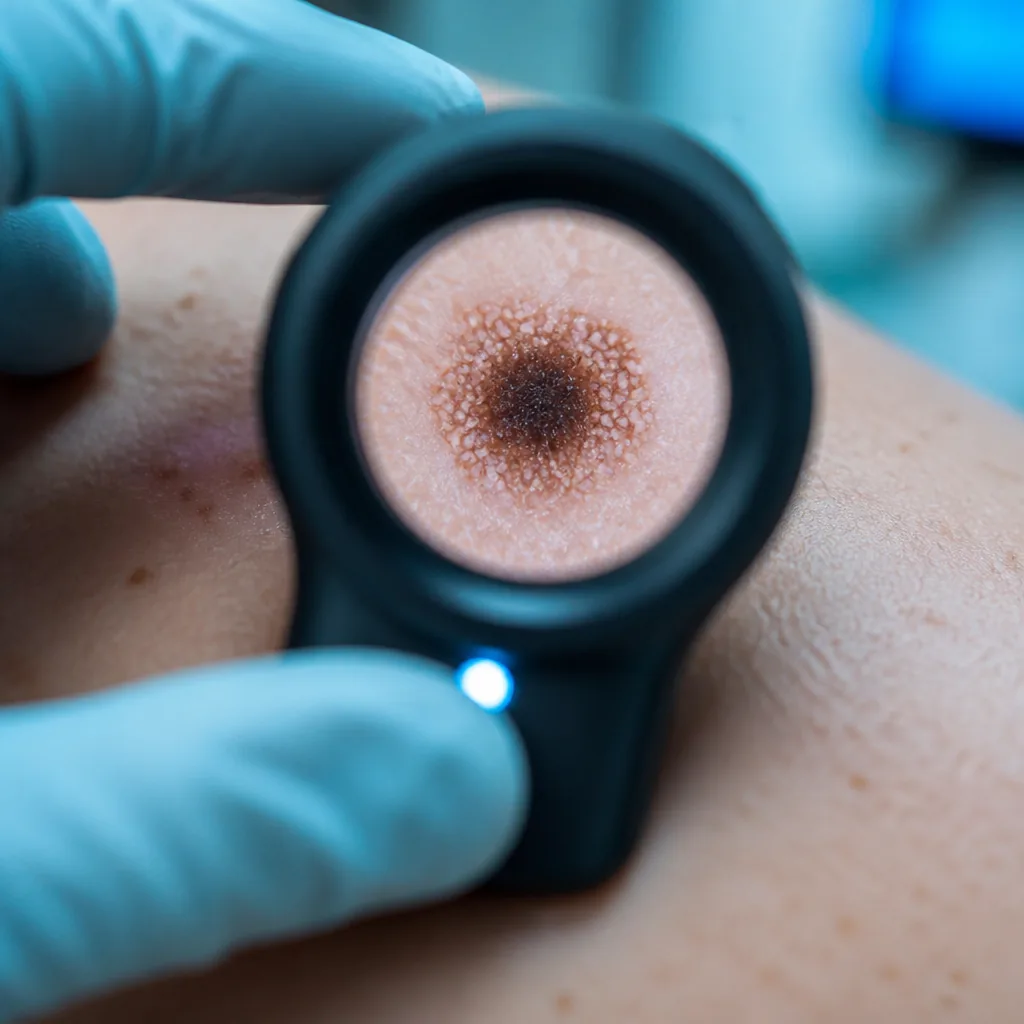
Dermatoscopy is a non-invasive skin examination using a special device — a dermatoscope. It magnifies the mole 10× to 100× and, thanks to polarised light, reveals structures invisible to the naked eye.
Step by step
- History — family history, previous oncological diseases, sun exposure.
- Whole-body visual inspection — including under hair, between fingers, genital area, palms and soles.
- Detailed dermatoscopic exam of every relevant mole.
- Digital documentation for at-risk patients.
- Evaluation and recommendations.
The exam is completely painless, takes 20–30 minutes and requires no special preparation.
What if a suspicious mole is found
We recommend surgical removal with histology. Local anaesthesia, 15–30 minutes, you go home immediately afterwards.
Important myth-buster: removing a mole DOES NOT spread the cancer.
How often to come
- Low risk (under 50 moles, no family history): every 2 years
- Medium risk (over 50 moles, sun exposure in youth, fair skin): once a year
- High risk (family history of melanoma, dysplastic nevi): every 3–6 months
Price in Prague
Dermatoscopy in Prague usually costs between CZK 800 and 2,500 depending on scope. See our pricing section.
Conclusion
A regular mole check is among the most important preventive exams. It takes less than half an hour, is painless, and in the case of early melanoma diagnosis can literally save your life.
Medically reviewed: