

Why get tested without symptoms
Sexually transmitted infections (STIs) share one trait: they are often silent. Chlamydia causes no symptoms in up to 70 % of women and half of men, gonorrhoea is similarly silent in women, and syphilis goes quiet for months or years after the first sore heals on its own. Meanwhile the infection can damage the fallopian tubes, prostate or epididymis and is passed on unknowingly.
Testing therefore makes sense not only when "something is wrong". We recommend it:
- after unprotected sex with a new or casual partner — even once,
- before starting a new relationship, ideally both partners together,
- when planning a pregnancy — some infections endanger the baby,
- once a year if you have multiple partners,
- if a partner tells you they tested positive — immediately, without waiting for symptoms,
- with any of the symptoms described below.
The most common STIs and how they show
Chlamydia — the most widespread bacterial STI in the Czech Republic. When symptomatic: burning on urination, discharge, in women lower abdominal pain and bleeding between periods. Untreated it leads to pelvic inflammation and infertility.
Gonorrhoea — thick yellow-green discharge, strong burning on urination, painful epididymis in men. Often symptom-free in women and in throat or rectal infection.
Syphilis — first a painless hard sore at the point of entry (genitals, mouth, anus) that heals by itself in 3–6 weeks. Weeks to months later a rash on the trunk, palms and soles, fatigue, swollen nodes. Then a long silent phase. Syphilis cases in the Czech Republic have been rising.
HIV — 2–4 weeks after infection some people get flu-like symptoms (fever, swollen nodes, rash), then years without complaints. Early treatment today allows a normal life expectancy and makes the virus untransmittable to partners.
Genital herpes — painful blisters and sores, burning, sometimes fever at the first outbreak; the virus stays in the body and can recur.
HPV — genital warts (condylomata), or no visible signs; high-risk types are linked to cervical, anal and throat cancer.
Mycoplasma, ureaplasma, trichomonas — less known but frequent causes of discharge, burning and recurrent inflammation that standard check-ups easily miss.
Hepatitis B and C — silent for a long time, detected only from blood.
What is tested
There is no single "test for everything". Each infection is detected differently, so we tailor the scope to your situation:
| Sample | What it detects |
|---|---|
| Blood | HIV, syphilis, hepatitis B and C, herpes if needed |
| Urine (first stream) | chlamydia, gonorrhoea, mycoplasma, ureaplasma, trichomonas — PCR |
| Swab from the urethra, cervix, throat or rectum | the same infections at the site of actual contact; in women also HPV |
| Clinical examination | sore, discharge, warts, rash — sometimes the diagnosis is made on the spot |
One important detail: if contact was oral or anal, a urine test will not catch it. A throat or rectal swab is then necessary — which is why the doctor asks about the specific type of contact. It is not curiosity; without it the test would be incomplete.
When a result is reliable: window periods
Every infection needs time after exposure before it becomes detectable. A test done too early can be falsely negative.
| Infection | Test makes sense from | Definitive exclusion |
|---|---|---|
| Chlamydia, gonorrhoea, mycoplasma | 1–2 weeks after contact | 2 weeks |
| HIV (4th-generation combined test) | 4–6 weeks | 12 weeks |
| Syphilis | 4–6 weeks | 12 weeks |
| Hepatitis B, C | 6–12 weeks | 6 months for hepatitis C |
In practice: after a risky contact come for the first test after 2 weeks (bacterial infections) and a blood check after 6 weeks; if negative and you remain concerned, blood is repeated at week 12. If you have symptoms, do not wait for any window — come immediately.
Tip: After a high-risk HIV exposure (a known HIV-positive partner not on treatment, shared needles) post-exposure prophylaxis (PEP) exists and must be started within 72 hours. We do not provide it — the HIV centres of university hospitals do; the nearest is at Bulovka Hospital. Do not wait for a test result.
How testing works at our clinic
- Booking online or by phone, no referral needed. You do not have to write anything specific in the note; "venereology" is enough.
- A private conversation with the doctor: type and date of contact, symptoms, previous infections, medication. Everything is part of medical records protected by medical confidentiality.
- Examination of the skin and mucosa of the genitals, mouth or rectum where relevant.
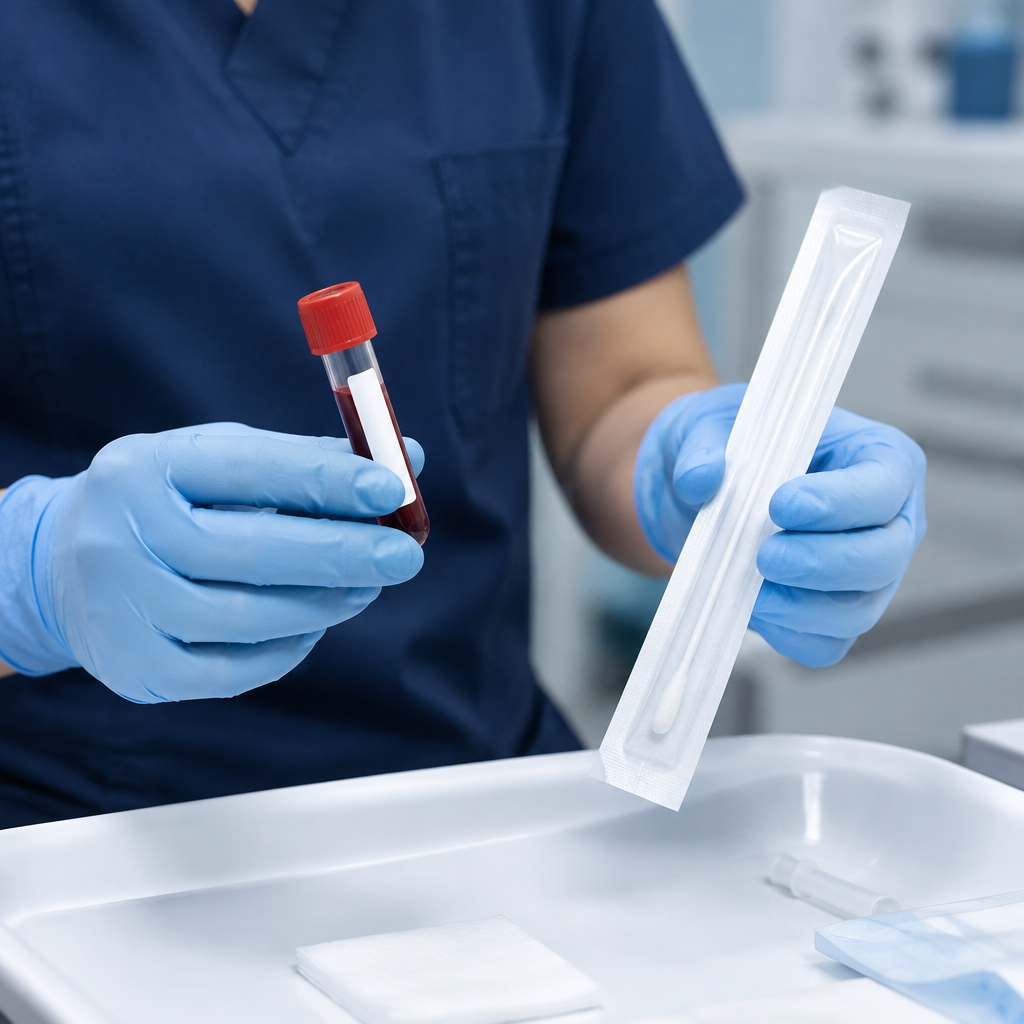
- Sampling — blood from a vein, a urine sample, swabs. A urethral swab is uncomfortable for a few seconds, not painful. The whole visit takes 20–30 minutes.
- Results within a few days (PCR from urine and swabs usually 2–4 working days, blood 3–5 days). We give them in person or by phone, never by e-mail unless you ask.
- Treatment — most bacterial infections are cured with antibiotics (chlamydia tablets, gonorrhoea a single injection, syphilis penicillin). Treating the partner and a follow-up test are always part of it, otherwise the infection "ping-pongs" back.
Testing is led by MUDr. Alexandra Reptišová, a dermatovenereologist who also works at the venereology department of the Central Military Hospital. Details of the service are on the STI testing page.
Discretion
Venereological examination at our clinic is self-paid, so no record is created with your health insurer and it does not appear in your insurer's care overview. Results are given to no one but you; if a result is positive we advise you how to inform your partner, but only you can contact them. Reception has no access to the reason for your visit — the calendar shows only "examination".
How much it costs
Venereology is not covered by any Czech health insurer. Prices from our price list:
| Service | Price |
|---|---|
| Sexually transmitted infection testing – package for women | CZK 4,500 |
| Sexually transmitted infection testing – package for men | CZK 3,900 |
| Testing for 1 sexually transmitted infection | CZK 2,500 |
| HPV virus testing | CZK 1,900 |
| PCR testing for HPV viruses | CZK 2,600 |
We agree the scope of sampling with you; often a targeted test for 2–3 infections is enough rather than a complete screening. You know the price before sampling; card and cash accepted.
When to book immediately
Do not wait for any window period if you have: discharge from the urethra or vagina, burning on urination, a painless sore or blisters on the genitals, a rash on the palms and soles, testicular or lower abdominal pain, or a partner has told you they tested positive. Appointments are usually available within a week, acute cases the same or next day.
Book an appointment — DermatologyExpert, Vítězné náměstí 9, Prague 6 – Dejvice, 2 minutes from Dejvická metro.
Author: MUDr. Alexandra Reptišová · Medically reviewed: 9/2026
Medically reviewed: