

What psoriasis is and why it happens
Psoriasis is a chronic autoimmune condition. The immune system mistakenly speeds up the renewal of skin cells from the usual month to just a few days, so the skin scales and becomes inflamed. It is not an infection and psoriasis is not contagious.
The tendency to develop it is inherited. The first flare is often triggered by tonsillitis or another infection, by stress, an injury to the skin, certain medications, smoking or alcohol.
What psoriasis looks like
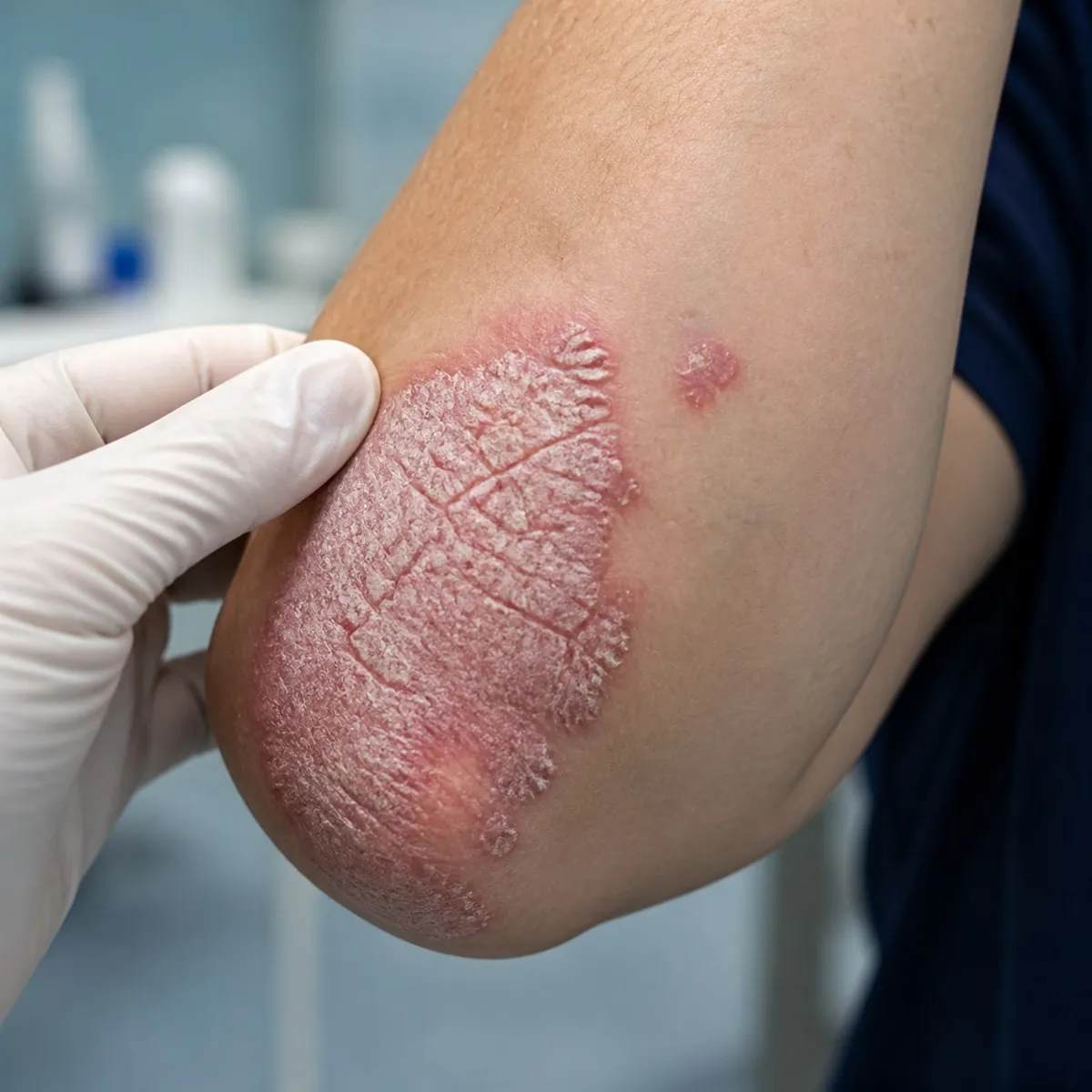
Plaque psoriasis — sharply defined red patches with silvery scales, typically on the elbows, knees and lower back.
Scalp psoriasis — scaling and itching of the scalp, frequently mistaken for dandruff.
Nail psoriasis — pitting, yellowish patches and crumbling of the nail.
Inverse psoriasis — smooth red patches in the armpits, groin and skin folds.
In some patients psoriatic arthritis develops alongside it — pain and stiffness in the joints, which matters a great deal to catch early.
Psoriasis is not merely a cosmetic problem of the skin. It carries a higher risk of joint involvement, metabolic syndrome and depression — all the more reason to treat it properly rather than simply endure it.
How psoriasis is treated today
Topical treatment. For milder forms, corticosteroid ointments and preparations containing vitamin D analogues; for the scalp, medicated shampoos and solutions. Regular emollient use is part of the foundation.
Phototherapy. Medical UVB light under a doctor's supervision, effective in more extensive disease.
Systemic treatment. For moderate to severe psoriasis, tablets that require regular monitoring.
Biologic therapy. The greatest advance of recent years. Modern biologic drugs target a specific part of the inflammatory pathway and in most patients can clear the skin completely or almost completely — including patients in whom everything else has failed. They are given by injection at intervals of weeks to months, and where the criteria are met they are covered by public health insurance. You can read how psoriasis treatment works at our clinic on the service page.
MUDr. Věra Víšková has worked with biologic therapy for many years. At the clinic she assesses whether this treatment is suitable for you, prepares the documentation and refers you to a biologic therapy centre at a faculty hospital.
When to see a dermatologist about psoriasis
- You suspect psoriasis and nobody has confirmed it — it is commonly mistaken for eczema or a fungal infection.
- The patches are spreading, itching, or limiting you at work or socially.
- The treatment you have used for years has stopped being enough. The options have moved on considerably in the meantime.
- Joint pain or stiffness has appeared, particularly in the morning.
- Psoriasis affects visible or sensitive areas — the face, hands, nails or genitals.
Do not settle for psoriasis
If someone once told you that nothing can be done about psoriasis, it was not true then — and today it is doubly untrue. Book an appointment at the DermatologyExpert clinic in Prague 6, Dejvice, and find out what current medicine can do for your skin. Our fees are listed in the price list.
Author: MUDr. Věra Víšková
Medically reviewed: