

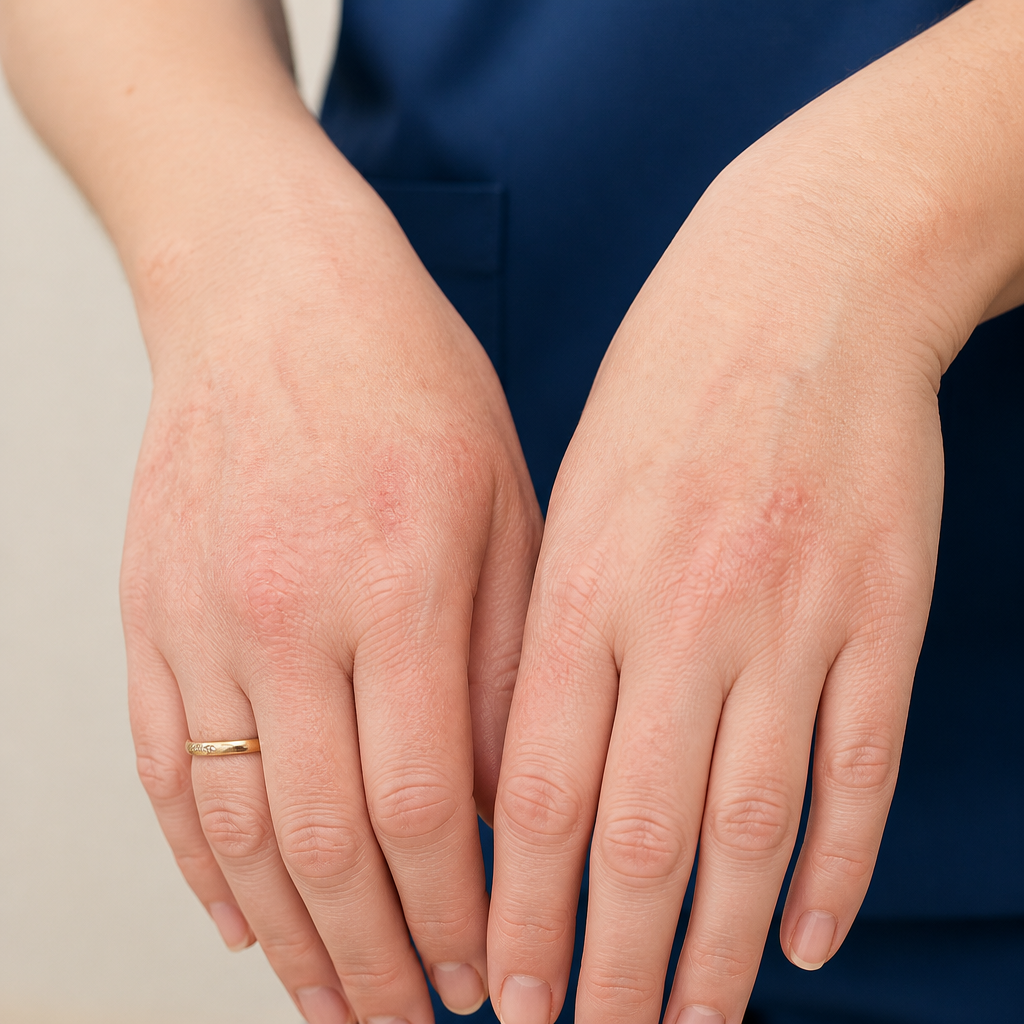
Atopic eczema is usually associated with children — see our parents' guide to childhood eczema. But eczema also affects adults: for some it persists from childhood, for others it appears for the first time in their twenties, thirties or later. Adult eczema has its own specifics — it more often involves the hands, eyelids and neck, complicates work and sleep, and is unnecessarily underestimated. The good news: today we can treat it better than ever.
Why eczema appears in adulthood
The mechanism is the same as in children: a damaged skin barrier and an over-reactive immune system, both largely inherited. In adulthood, triggers become harder to avoid: stress, frequent hand washing and disinfection, work with chemicals or in gloves, dry office air, sweating during sport. The classic picture is hand eczema — the most common occupational skin problem among healthcare workers, hairdressers, cooks and cleaners.
The foundation: restoring the skin barrier
Emollients — moisturising creams and ointments — are the cornerstone of treatment for adults too. Apply at least twice a day and always within 3–5 minutes after showering, when skin binds water best. Keep showers short and lukewarm; use fragrance-free, soap-free washes. Cream the hands after every wash, and at night apply a richer product under cotton gloves.
When moisturising isn't enough
Topical anti-inflammatory treatment: for flares, topical corticosteroids are first-line — used correctly under a doctor's guidance they are safe, and unfounded fear only prolongs suffering. For the face, eyelids and skin folds, modern non-steroid ointments (tacrolimus, pimecrolimus) are ideal and can be used long-term as maintenance.
Systemic treatment for severe eczema: if topical therapy isn't enough, phototherapy and — above all — modern systemic and biologic treatments (e.g. dupilumab or JAK inhibitors) are available. These target inflammation, dramatically reduce itching and eczema extent in most patients, and restore sleep. Our dermatologist MUDr. Věra Víšková has long-standing experience with biologic therapy and will assess whether it's right for you — it is covered by Czech public health insurance.
What doesn't work: drastic blind elimination diets, miracle creams from the internet with unknown ingredients, excessive skin disinfection, and constantly switching cosmetics.
When to see a dermatologist
- Eczema doesn't respond to regular moisturising and over-the-counter products
- Itching wakes you up at night, you scratch until you bleed
- Lesions weep, turn yellow or you develop a fever — possible infection
- Hand eczema complicates your work (or makes you consider changing it)
- You repeatedly apply corticosteroids on your own, without medical supervision
No referral is needed and eczema treatment — including biologic therapy — is covered by public health insurance.
Frequently asked questions
Can eczema first appear in adulthood? Yes, and it isn't rare. Sometimes it's a return of childhood eczema after years of calm, sometimes an entirely new onset — typically during stressful periods.
Is eczema contagious? No, atopic eczema is not infectious.
Is eczema linked to diet? In adults, only exceptionally. Eliminate foods only after discussion with a doctor, never preventively.
Do sea and sun help? Most atopics feel relief at the sea, but the skin must not burn. Chlorinated water bothers some patients — showering immediately after swimming and moisturising helps.
Eczema and working in gloves? Wear thin cotton gloves under rubber ones — sweat and occlusion make eczema worse. For occupational eczema we also advise on proper skin protection at work.
Stop scratching, start living
You don't have to "put up with" adult eczema. Book online at the DermatologyExpert clinic (Vítězné náměstí 9, Prague 6 – Dejvice) — we will design care that fits your skin, and for severe forms we will assess your eligibility for modern biologic therapy.
Author: MUDr. Gabriela Charouzová
Medically reviewed: